Beschrijving
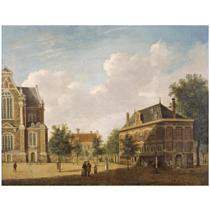
DESCRIPTION: signed and dated lower right: J. Ekels Fec. 1753 oil on canvas. PROVENANCE: Earl of Cork and Orrery; Thence by descent to the Hon. Richard Boyle, Huntercombe Manor; Sale, London, Sotheby's, 21 March 1956, lot 130, for £210 to The Fine Art Society; Anonymous sale, London, Christie's, 24 April 1981, lot 109. CATALOGUE NOTE: Jan Ekels the Elder was born in Amsterdam, where he was apprenticed to the landscape painter Dirk Dalen. He was well-known as a painter of cityscapes, of which the majority are of his hometown, Amsterdam. His son, Jan Ekels the Younger became a painter as well, and is mostly known as a painter of scenes from every day life and allegorical themes, such as the Five Senses. Until the later 1650s, relatively accurate architectural views within the Dutch towns were still rarely painted. In the 17th Century, a central place within the topographical genre was held by the painter Jan van der Heyden (1637-1712), who developed his own style in cityscapes, which was characterized by a strictly naturalistic rendering of the location, as well as occasional subtle manipulation of the perspective to emphasize particular details. In the 18th Century , Van der Heyden inspired an extensive following of architectural painters, who adopted his concern with atmospheric clarity and detail. Painters such as Cornelis Pronk (1691-1759), Jan de Beijer (1703-1785), Jan ten Compe (1713-1716), who had been Ekel's fellow pupil in Dalen's workshop, and of course Jan Ekel the Elder himself.1 This cityscape of the Westerhal near the Westerkerk in Amsterdam, shows Ekels' finely rendering of masonry, cobblestones and brickwork, as well as the vivid detail in his drawing of the trees and foliage. The view is slightly optically adjusted. The square is expanded and the distance between the church and the Keizersgracht is enlarged. The Westerhal on the right, here seen from the back, was built in 1619 and demolished in 1857. It served as a guardhouse and and at street level there was a meatmarket; two men in butcher's aprons are depicted beside open doors behind which raw meat can be seen hanging. A photograph (fig. 1) shows the actual situation where the Westhal has been replaced by Amsterdam's Gay Monument.The Westerhal Near The Westerkerk In Amsterdam
Ekels, Jan
(Amsterdam, 21 november 1724
-
Amsterdam,
22 november 1781)
Details
- Databanknummer:
- 49805
- Lotnummer:
- -
- Advertentietype
- Archief
- Instelling:
- Sotheby's
- Veilingdatum:
- -
- Veilingnummer:
- -
- Stad
- -
- Limietprijs
- -
- Aankoopprijs
- -
- Verkoopprijs
- -
- Hamerprijs
- -
- Status
- Verkocht
Technische details
- Kunstvorm:
- Schilder- en Tekenkunst
- Technieken:
- Olieverf
- Dragers:
- Doek
- Lengte:
- 39 cm
- Breedte:
- 49.5 cm
- Hoogte:
- -
- Oplage:
Beschrijving
DESCRIPTION: signed and dated lower right: J. Ekels Fec. 1753 oil on canvas. PROVENANCE: Earl of Cork and Orrery; Thence by descent to the Hon. Richard Boyle, Huntercombe Manor; Sale, London, Sotheby's, 21 March 1956, lot 130, for £210 to The Fine Art Society; Anonymous sale, London, Christie's, 24 April 1981, lot 109. CATALOGUE NOTE: Jan Ekels the Elder was born in Amsterdam, where he was apprenticed to the landscape painter Dirk Dalen. He was well-known as a painter of cityscapes, of which the majority are of his hometown, Amsterdam. His son, Jan Ekels the Younger became a painter as well, and is mostly known as a painter of scenes from every day life and allegorical themes, such as the Five Senses. Until the later 1650s, relatively accurate architectural views within the Dutch towns were still rarely painted. In the 17th Century, a central place within the topographical genre was held by the painter Jan van der Heyden (1637-1712), who developed his own style in cityscapes, which was characterized by a strictly naturalistic rendering of the location, as well as occasional subtle manipulation of the perspective to emphasize particular details. In the 18th Century , Van der Heyden inspired an extensive following of architectural painters, who adopted his concern with atmospheric clarity and detail. Painters such as Cornelis Pronk (1691-1759), Jan de Beijer (1703-1785), Jan ten Compe (1713-1716), who had been Ekel's fellow pupil in Dalen's workshop, and of course Jan Ekel the Elder himself.1 This cityscape of the Westerhal near the Westerkerk in Amsterdam, shows Ekels' finely rendering of masonry, cobblestones and brickwork, as well as the vivid detail in his drawing of the trees and foliage. The view is slightly optically adjusted. The square is expanded and the distance between the church and the Keizersgracht is enlarged. The Westerhal on the right, here seen from the back, was built in 1619 and demolished in 1857. It served as a guardhouse and and at street level there was a meatmarket; two men in butcher's aprons are depicted beside open doors behind which raw meat can be seen hanging. A photograph (fig. 1) shows the actual situation where the Westhal has been replaced by Amsterdam's Gay Monument.Geen prijsinformatie? Sluit een abonnement af.