Beeldmateriaal

Beschrijving
Signed and dated (on the right edge), signed and dated again and titled (on the reverse).
Condition:
Extremities slightly rubbed with chips in places (mostly at the edges), few areas of fine craquelure, dust in recesses, otherwise in good condition.
Exhibited:
Schiedam, Stedelijk Museum, Bram Bogart, 3 - 30 October 1967.
Provenance:
Collection Steef de Vries, Deventer.
Notes:
Bram Bogart was a Dutch-born artist who became a key figure in post-war European abstraction. Bogart's profession originally was painting houses, which gave him extensive experience with the medium. This would later prove invaluable to his artistic practice. During the Second World War years, he spent a year at the Art Academy in The Hague, in part to avoid being sent to work in Germany by the occupying forces. After moving to Paris and Belgium, Bogart developed a deeply personal visual language rooted in material, colour, and form. The artist is widely known for his later, sculptural paintings made with thick layers of oil paint. His early paintings, however, show a more exploratory side, using darker colours.
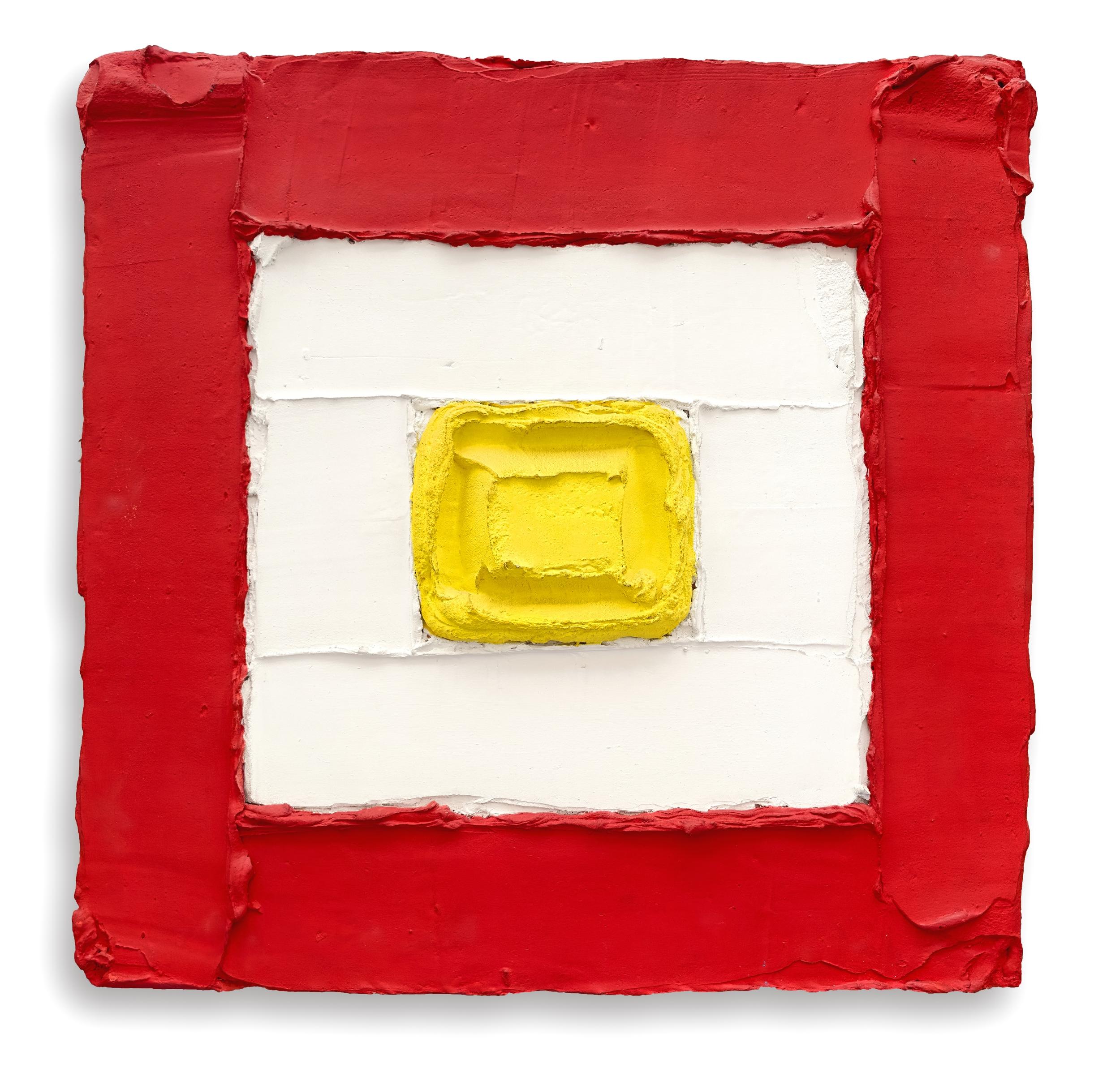
'Roodwitgeel' is very typical for his style, which is characterised by their heavy impasto applications of colour in patterns or loose shapes on thick wooden panels. Bogart mixed his own paint using oil, pigment, and water, creating works that are almost three-dimensional. Since the water component dried much faster than the oil, many small ‘drying channels’ formed within the thick, paste-like paint mass. These channels allowed the heavy oil paint layers on the canvas to breathe and dry from the inside outwithout them, most of his works would have collapsed over time.
The artist represented Belgium in the 1971 Venice Biennale, and his work can be found in the collections of several museums, among others the Centraal Museum in Utrecht and the Stedelijk Museum voor Actuele Kunst in Ghent.
Roodwitgeel / Redwhiteyellow (1966 - 1967)
Bogart, Bram
(Delft, 12 juli 1921
-
Sint Truiden,
2 mei 2012)
Details
- Databanknummer:
- 95138
- Lotnummer:
- -
- Advertentietype
- Archief
- Instelling:
- Adams Amsterdam Auctions BV.
- Veilingdatum:
- -
- Veilingnummer:
- -
- Stad
- -
- Limietprijs
- -
- Aankoopprijs
- -
- Verkoopprijs
- -
- Hamerprijs
- -
- Status
- Niet verkocht
Technische details
- Kunstvorm:
- Schilder- en Tekenkunst
- Technieken:
- Materieschilderij
- Dragers:
- Paneel
- Lengte:
- 102 cm
- Breedte:
- 105 cm
- Hoogte:
- 8 cm
- Oplage:
- -
Beschrijving
Signed and dated (on the right edge), signed and dated again and titled (on the reverse).
Condition:
Extremities slightly rubbed with chips in places (mostly at the edges), few areas of fine craquelure, dust in recesses, otherwise in good condition.
Exhibited:
Schiedam, Stedelijk Museum, Bram Bogart, 3 - 30 October 1967.
Provenance:
Collection Steef de Vries, Deventer.
Notes:
Bram Bogart was a Dutch-born artist who became a key figure in post-war European abstraction. Bogart's profession originally was painting houses, which gave him extensive experience with the medium. This would later prove invaluable to his artistic practice. During the Second World War years, he spent a year at the Art Academy in The Hague, in part to avoid being sent to work in Germany by the occupying forces. After moving to Paris and Belgium, Bogart developed a deeply personal visual language rooted in material, colour, and form. The artist is widely known for his later, sculptural paintings made with thick layers of oil paint. His early paintings, however, show a more exploratory side, using darker colours.
'Roodwitgeel' is very typical for his style, which is characterised by their heavy impasto applications of colour in patterns or loose shapes on thick wooden panels. Bogart mixed his own paint using oil, pigment, and water, creating works that are almost three-dimensional. Since the water component dried much faster than the oil, many small ‘drying channels’ formed within the thick, paste-like paint mass. These channels allowed the heavy oil paint layers on the canvas to breathe and dry from the inside outwithout them, most of his works would have collapsed over time.
The artist represented Belgium in the 1971 Venice Biennale, and his work can be found in the collections of several museums, among others the Centraal Museum in Utrecht and the Stedelijk Museum voor Actuele Kunst in Ghent.
Geen prijsinformatie? Sluit een abonnement af.