Beschrijving
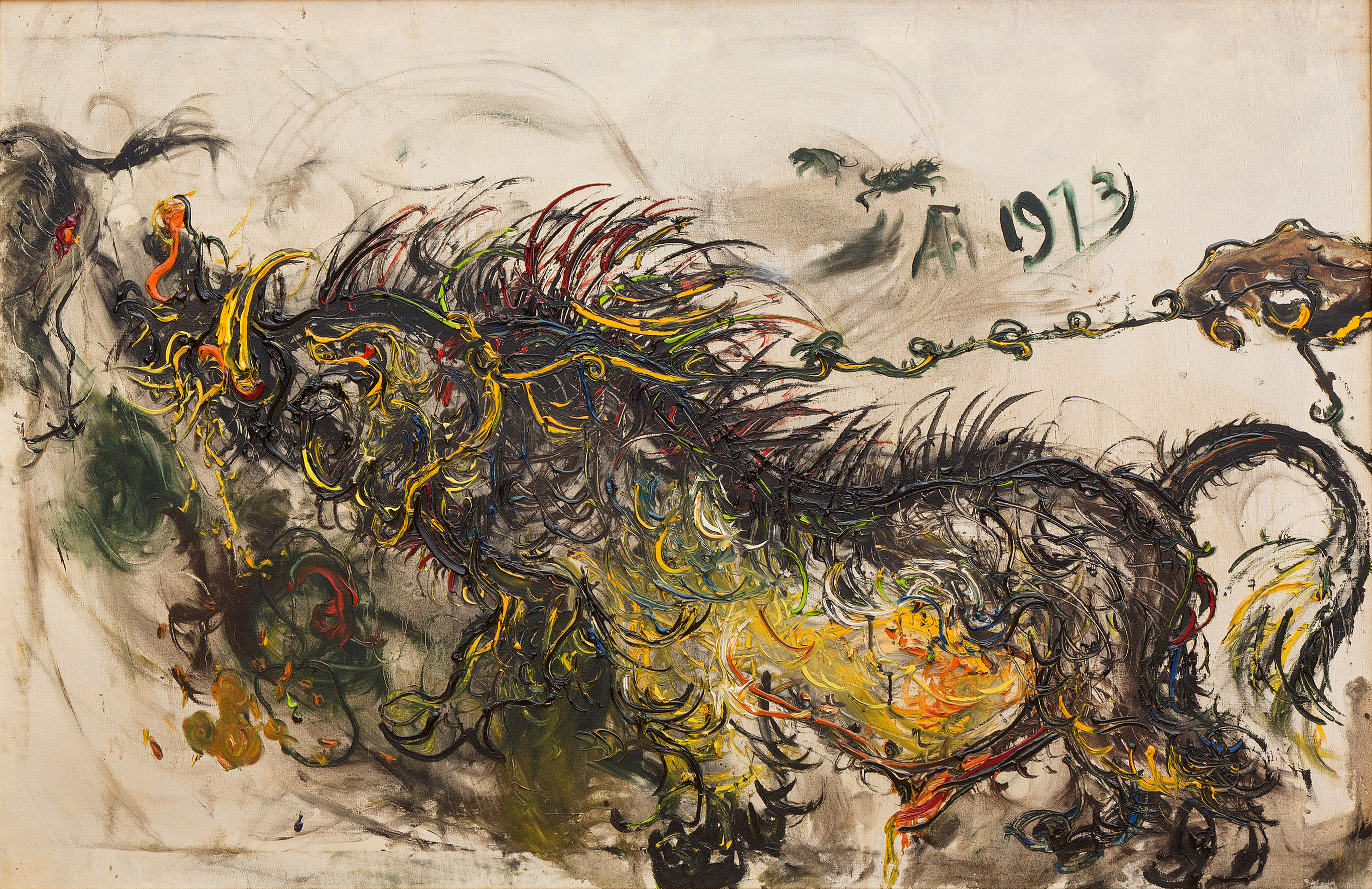
Signed and dated 1973 upper right. Provenance: acquired directly from the artist in the Yogyakarta in 1973 and since that time in the same private collection in the Netherlands.
Statement of the present owner:
'The painting was bought by my husband, when he was living and working in Indonesia in the early 1970’s. My husband was a great lover of modern art and he was very impressed by Affandi’s style and the energy and vigour in his paintings. On a visit to Yogyakarta, he paid a visit, almost a pilgrimage, to Affandi’s house. He watched him actually painting this painting. Affandi seemed to be almost attacking the canvas; he drew the outlines of the animals first, with his fingers and then squeezed and squirted the paint straight onto the canvas, grabbing one tube after another in a frenzy of energy.
My husband had very little money at the time, but he just had to have the painting and put every last penny together to pay the price, after heated negotiations in Bahasa'.
Affandi is probably Indonesia’s best known painter. Mostly self-taught, he won international acclaim from the 1950s onwards. The influential English art critic John Berger for example called him ‘a genius’. He was born Boerhanoedin Affandi Koesoema in Jatitujuh, Indramayu (part of Cirebon), West Java in 1907 as a son of Raden Koesoema, surveyor of a sugarfactory. After his father died when he was still at school, he stayed with an artistic family in Jakarta where he was introduced to oil painting by the painter Sudjojono. In 1929 he met his future wife Maryati who definitely stimulated Affandi’s painting career. Their daughter Kartika became an artist too.
Affandi’s work has an undeniably characteristic style that can be described as dynamic expressionism. His social involvement resounds in his subject matter. The technique he uses in his paintings is a personal form of action painting in which he squeezes the paint directly from the tube on the canvas and subsequently uses his hands to draw the accents. The story goes that he came across this technique by accident. Unable to find a pencil one day, he squeezed the paint on the canvas and found out that the result was very lively. The swirling movement in his painting and the gripping subject matter resulted in an utterly personal style that is unrivalled.
Affandi sought to portray life as he saw it. His representation of reality is raw, unadorned, even ugly sometimes. He also encouraged fellow Indonesian artists to strive for authenticity rather than to depict an idealized, imaginary Indonesia as the Mooi Indië-painters and members of Pita-Maha did.
‘I don’t base my paintings on beauty. My life is based on humanity. With my works, I attempt to stir people’s sense of humanity’, he once told an art critic.1
This commitment to honest expression and authenticity for Affandi implies painting nudes and erotic themes. His nudes are not so much meant to please the eye as to draw attention to human suffering or social abuse. The same applies to the painting of a wild boar at auction. As Eddy Soetriyono states in his essay ‘Affandi, the nude, and the erotic’ referring to a similar boar-painting: ‘… to convey the idea that raging lust can be deeply spiteful, Affandi effectively features in one of his paintings a male boar going frantic with the urge to copulate - its red organ ready to charge anything at the first opportunity.’2 He continues quoting Affandi himself: ‘Don’t take what’s there on the surface only. Behind all this is just me with my gloom. Don’t find out just the meaning of what is depicted, try to interpret what the images allude to.’3
As a renowned artist, Affandi had numerous exhibitions all over the world. He worked in India, went to Europe where his paintings were on show in Paris, London, Brussels and Rome and visited the United States three times. He represented the independent Republic of Indonesia at the Biennale in Sao Paulo (1953) and Venice (1954). In later life he received various important prizes and recognitions for his art work and effort for human rights.
From 1965 onwards he established the Affandi Museum in Yogyakarta. The architectural design was by the artist himself. He died in Yogyakarta on May 23 1990 and was buried on the museum premises.
1. Eddy Soetriyono , ‘Affandi, the nude, and the erotic’ in: Sardjana Sumichan (ed.), Affandi, Vol I, Jakarta/Singapore 2007, p.154
2. Ibid. p.155
3. Ibid. p.156
Details
- Databanknummer:
- 79643
- Lotnummer:
- -
- Advertentietype
- Archief
- Instelling:
- Venduehuis Den Haag
- Veilingdatum:
- -
- Veilingnummer:
- -
- Stad
- -
- Limietprijs
- -
- Aankoopprijs
- -
- Verkoopprijs
- -
- Hamerprijs
- -
- Status
- Verkocht
Technische details
- Kunstvorm:
- Schilder- en Tekenkunst
- Technieken:
- Olieverf
- Dragers:
- Doek
- Lengte:
- 98 cm
- Breedte:
- 151 cm
- Hoogte:
- -
- Oplage:
- -
Beschrijving
Signed and dated 1973 upper right. Provenance: acquired directly from the artist in the Yogyakarta in 1973 and since that time in the same private collection in the Netherlands.
Statement of the present owner:
'The painting was bought by my husband, when he was living and working in Indonesia in the early 1970’s. My husband was a great lover of modern art and he was very impressed by Affandi’s style and the energy and vigour in his paintings. On a visit to Yogyakarta, he paid a visit, almost a pilgrimage, to Affandi’s house. He watched him actually painting this painting. Affandi seemed to be almost attacking the canvas; he drew the outlines of the animals first, with his fingers and then squeezed and squirted the paint straight onto the canvas, grabbing one tube after another in a frenzy of energy.
My husband had very little money at the time, but he just had to have the painting and put every last penny together to pay the price, after heated negotiations in Bahasa'.
Affandi is probably Indonesia’s best known painter. Mostly self-taught, he won international acclaim from the 1950s onwards. The influential English art critic John Berger for example called him ‘a genius’. He was born Boerhanoedin Affandi Koesoema in Jatitujuh, Indramayu (part of Cirebon), West Java in 1907 as a son of Raden Koesoema, surveyor of a sugarfactory. After his father died when he was still at school, he stayed with an artistic family in Jakarta where he was introduced to oil painting by the painter Sudjojono. In 1929 he met his future wife Maryati who definitely stimulated Affandi’s painting career. Their daughter Kartika became an artist too.
Affandi’s work has an undeniably characteristic style that can be described as dynamic expressionism. His social involvement resounds in his subject matter. The technique he uses in his paintings is a personal form of action painting in which he squeezes the paint directly from the tube on the canvas and subsequently uses his hands to draw the accents. The story goes that he came across this technique by accident. Unable to find a pencil one day, he squeezed the paint on the canvas and found out that the result was very lively. The swirling movement in his painting and the gripping subject matter resulted in an utterly personal style that is unrivalled.
Affandi sought to portray life as he saw it. His representation of reality is raw, unadorned, even ugly sometimes. He also encouraged fellow Indonesian artists to strive for authenticity rather than to depict an idealized, imaginary Indonesia as the Mooi Indië-painters and members of Pita-Maha did.
‘I don’t base my paintings on beauty. My life is based on humanity. With my works, I attempt to stir people’s sense of humanity’, he once told an art critic.1
This commitment to honest expression and authenticity for Affandi implies painting nudes and erotic themes. His nudes are not so much meant to please the eye as to draw attention to human suffering or social abuse. The same applies to the painting of a wild boar at auction. As Eddy Soetriyono states in his essay ‘Affandi, the nude, and the erotic’ referring to a similar boar-painting: ‘… to convey the idea that raging lust can be deeply spiteful, Affandi effectively features in one of his paintings a male boar going frantic with the urge to copulate - its red organ ready to charge anything at the first opportunity.’2 He continues quoting Affandi himself: ‘Don’t take what’s there on the surface only. Behind all this is just me with my gloom. Don’t find out just the meaning of what is depicted, try to interpret what the images allude to.’3
As a renowned artist, Affandi had numerous exhibitions all over the world. He worked in India, went to Europe where his paintings were on show in Paris, London, Brussels and Rome and visited the United States three times. He represented the independent Republic of Indonesia at the Biennale in Sao Paulo (1953) and Venice (1954). In later life he received various important prizes and recognitions for his art work and effort for human rights.
From 1965 onwards he established the Affandi Museum in Yogyakarta. The architectural design was by the artist himself. He died in Yogyakarta on May 23 1990 and was buried on the museum premises.
1. Eddy Soetriyono , ‘Affandi, the nude, and the erotic’ in: Sardjana Sumichan (ed.), Affandi, Vol I, Jakarta/Singapore 2007, p.154
2. Ibid. p.155
3. Ibid. p.156
Geen prijsinformatie? Sluit een abonnement af.